The upsized Treasury buyback provides more insurance — and insurance is the interest-cost story
Liquidity management and borrowing-cost management are two sides of the same coin. A meltdown in the Treasury market is detrimental, not least because of the interest burden: maintaining market order with relatively low-cost insurance protects the fiscal position.
Stanley Druckenmiller, Treasury Secretary Scott Bessent's former mentor from their Soros years, and an all-time investing legend, used an August Wall Street Journal op-ed, "Let the Bond Market Speak," to call the Treasury's decision to more than double its long-term bond buybacks a mistake: yield suppression, he argued, dressed up as liquidity support, with no sign of the liquidity freeze that would justify it. Bessent pushed back that his old mentor "changes his mind a lot."
Both are likely right. Liquidity management and borrowing-cost management are two sides of the same coin. A meltdown in the Treasury market is detrimental, not least because of the interest burden: maintaining market order with relatively low-cost insurance protects the fiscal position. The Treasury built its regular buyback program to support liquidity in off-the-run securities, running regular operations since 2024, to preempt disorderly moves like the 2020 "dash-for-cash."
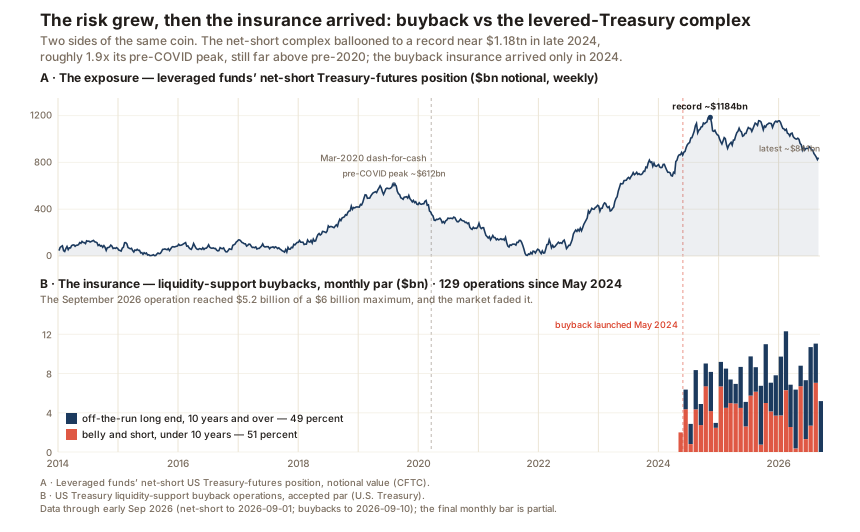
The reason to scale up the buyback program is that leveraged funds' net-short Treasury-futures positions ballooned to a record ~$1.18tn in late 2024, approximately 1.9x their pre-COVID peak (~$612bn). A disorderly unwind of this levered Treasury complex (or for that matter, of the yen carry trade) into the broader Treasury cash market would make the debt burden much more expensive.
The buyback program was created after the March-2020 "dash-for-cash" as a preventive measure. In that unwinding episode, mutual funds sold $266bn of Treasuries in Q1-2020 and hedge funds sold a net ~$173bn in a matter of weeks, and the Federal Reserve stepped in to stabilize markets: purchasing up to $75bn of Treasuries a day (and for the full-year 2020, almost $2tn were purchased due to the COVID shock). A single day of that response dwarfs the current $6bn buyback. Against ~$32tn of marketable debt, ~$220bn of cumulative buybacks of illiquid off-the-runs (cheap compared to the newly issued on-the-runs) is cheap tail insurance. Long-end buyback operations were previously capped at $2bn each; on August 19, Treasury announced it would at least double that to $4bn per operation, effective September 9, and the September-10 operation was set to a $6bn maximum (~$5.2bn accepted). A rational response to a larger exposure, not mission creep.
Bessent's own framing is liquidity, not cost:
"…we're going to do more bond buybacks, which is just taking the most illiquid portion of the bond market, liquefying it, and giving the bond buyers money to buy more." — Treasury Secretary, SMU Cox fireside
And there is a structural reason the true motivation stays hidden: a Treasury Secretary cannot publicly justify a buyback by pointing at a growing systemic fault line. Saying "the risk-free market is more fragile" is itself destabilizing, capable of catalysing the very run it insures against. So the "borrowing costs / market functioning" framing is what one should expect regardless of the real rationale; you can't wait for the Secretary to announce rising risk. New issuance is skewed towards shorter maturities, so current borrowing costs are being lowered. (A structural feature of financial-stability communication, not a claim about any official's private view.)
Why it matters
Druckenmiller is right that a $6bn operation cannot set the level of a $32tn market. But that is the wrong lens. As insurance for an orderly market, the buyback is not price management; it is cheap tail insurance whose payoff shows up only in the crisis it prevents. That is the reading the "failed intervention" framing misses. The market judges the stated objective, the level of yields, and fades it, missing the unstated goal: maintain market stability. So far, so good, but time will tell.
Public sources: U.S. Treasury buyback operations; CFTC futures positioning; Federal Reserve / NY Fed research and operating data on the 2020 Treasury market stress.
Commentary: S. Druckenmiller, "Let the Bond Market Speak" (WSJ, Aug 2026); Treasury Secretary remarks (SMU Cox fireside); contemporaneous reporting, Sep 2026.
Disclaimer: This post is for informational and educational purposes only and does not constitute investment advice or a recommendation to buy or sell any security. Securities services through Weild & Co., member FINRA/SIPC.